A Landrace of people
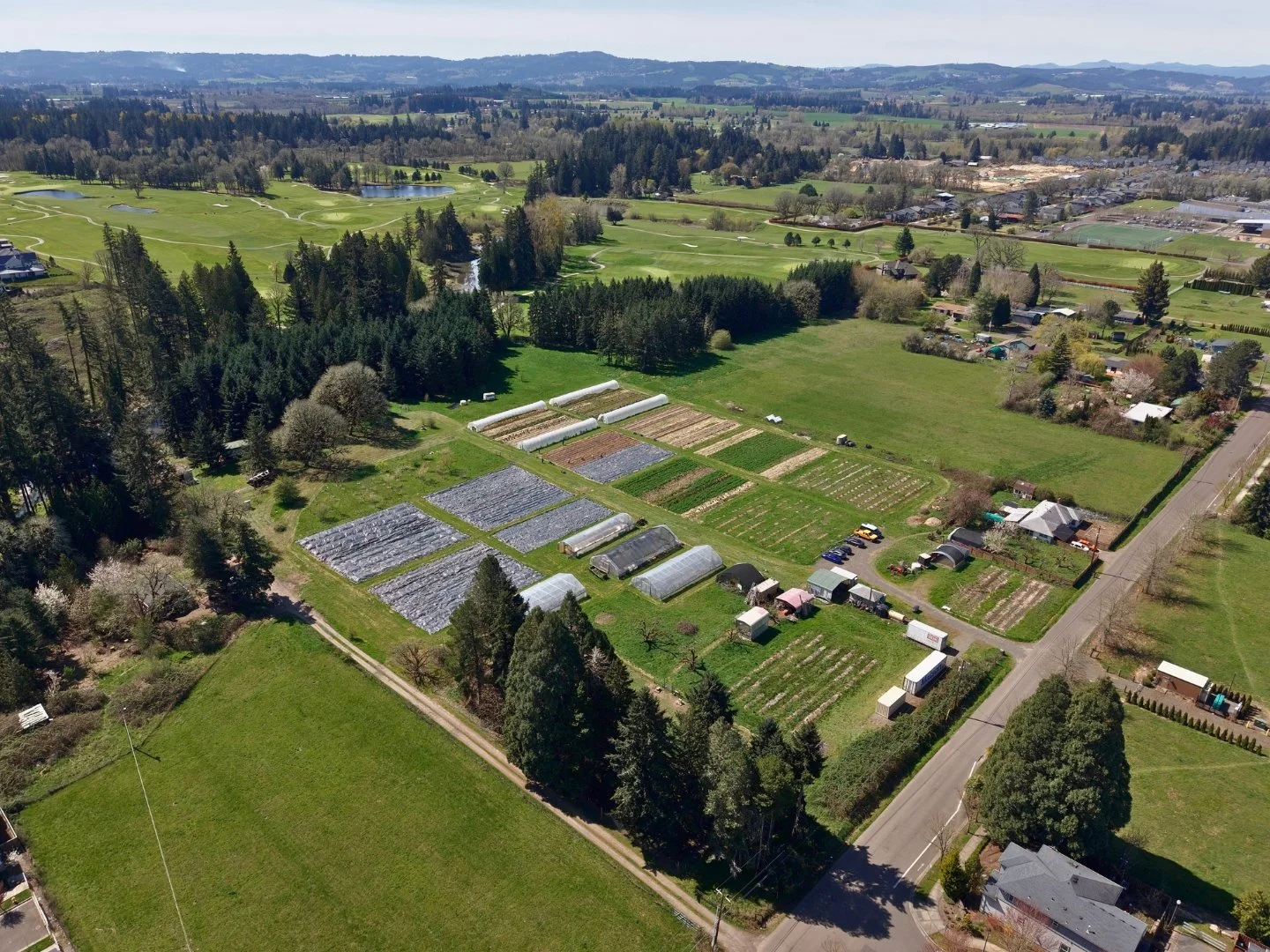
The farm from above looking southwest towards the Chehalem mountains.
A bulletin from our founder, Justin.
In a nutshell
The land: After 75 years of stewardship, the Serrurier family is selling the 24 acres we farm in South Hillsboro, for millions below its appraised value, helping keep it a farm instead of turning it into development.
The plan: We’re working to purchase it in partnership with the City of Hillsboro and Centro Cultural. When the purchase closes, the land will become public land held by the City, while Working Theory Farm continues farming it and running our youth crews, elder visits, and Free Food Mercado.
The big win: In July, after hundreds of you wrote and testified, Metro Council awarded $3 million toward the purchase, the largest award of the funding cycle.
What's left: We still need to raise the remaining $3 million in collaboration with our partners at the City and Centro. We’re starting by asking you to help us raise $100,000. These first funds will support a dedicated campaign lead, grant-writing, project management, and the capacity-building work needed to bridge the gap and seize this opportunity. Your gift or pledge now can help us build the foundation for a future where this land stays in service to the community for generations to come.
The full story and farm flowers are below!
Dear Friends of the Farm,
David usually writes these letters, and if you've been reading them for a while, you know why. He has a gift for noticing the small thing everyone else walked past, like the first ripe row or the quiet kid who finally cracked a joke on the wash line, and bringing it here so you can see it too. He’s lent me the pen this time. I'll do my best to return it in decent shape.
Land has more than monetary value
Late September is an honest time on a farm. The ground has been dry since July, and the summer crops are tired. We stopped tilling here back in 2021 (hat tip to Capers), so this time of year the beds can look a bit ragged by conventional standards. Crops get cut at the soil line, and their roots stay put to feed the fungi and leave little channels for the winter rain to find its way down. To an untrained eye, it can look like neglect. Anthony Boutard, who farmed out near Gaston for a couple of decades, used to point out that the mess is the machinery. I've been thinking about that a lot this year, because the story of these 24 acres has been messy too, and it has also been working exactly as it should.
I came to farming sideways. Before any of this, I taught high school in California. I worked in tough communities with kids who were struggling to find success in a traditional classroom. I noticed that the kids who struggled most often came alive when the context shifted to something that broke the script, like when we went outside or trusted them to take a leadership role. I got interested in what it might look like to build a program around those very ideas. I spent a year as an apprentice on an educational farm in Massachusetts before coming back to Oregon and starting Working Theory, working eighteen hours a day to get my fledgling operation off the ground.
I stumbled on this lovely piece of land in the winter of 2012 and immediately knew I was home. There is no better farmland in this whole valley. In my friendship with Pat Serrurier, the free-spirit matriarch of the family that owns this land, I came to understand the meaning of a kindred spirit. For the first several years I farmed commercially, first with a mobile farm stand and then selling fancy food to fancy restaurants, and mostly it was me learning the hard way. In 2019 we finally became a nonprofit, and the vision I'd had in that classroom was ready to put down roots.
This land obviously has a much longer story than mine, or even the Serruriers'. The Indigenous people of the Tualatin Valley including the Kalapuyan Atfalati, who lived here for as many as 10,000 years before Euro-American settlers arrived. They farmed this valley with fire. Deliberate burns on the valley floor kept the prairie open and encouraged camas, whose bulbs were one of their staple foods. Much of what later settlers took for untouched wild prairie was actually a tended landscape, shaped over millennia by the people who lived here. Many Kalapuya descendants today are part of the Confederated Tribes of Grand Ronde. We farm on their homeland, and we try to remember that every time we talk about "our" land.
How we got here
Over the 75 years that the Serrurier family has stewarded this land, South Hillsboro has grown up around it, rooftop by rooftop, yet they refused to sell. Let's be clear: this is valuable land, folks. It's zoned for development and sits right in the path of one of the fastest-changing corners of the region. The easy offers have always been there.
Among many great lines, Pat is famous for saying,
"If we had all that money, we'd just be worried about money. It's way more fun worrying about a farm.”
We moved fast, engaging our longtime partners at Centro Cultural and ultimately the City of Hillsboro, but the Serruriers did far more than simply open the door. They agreed to sell the land for millions of dollars below its appraised value, a discount they're giving because they believe in what happens here. They joined calls, wrote letters, and put their faith in this before anyone could promise it would work. You won't find that kind of generosity on a balance sheet, yet it permeates everything we do here. You'll find it on Tuesday mornings when our elders walk the rows, on Saturdays when a new crew of teenagers learns what they're capable of, and every time a family leaves the Mercado with a full bag of veggies.
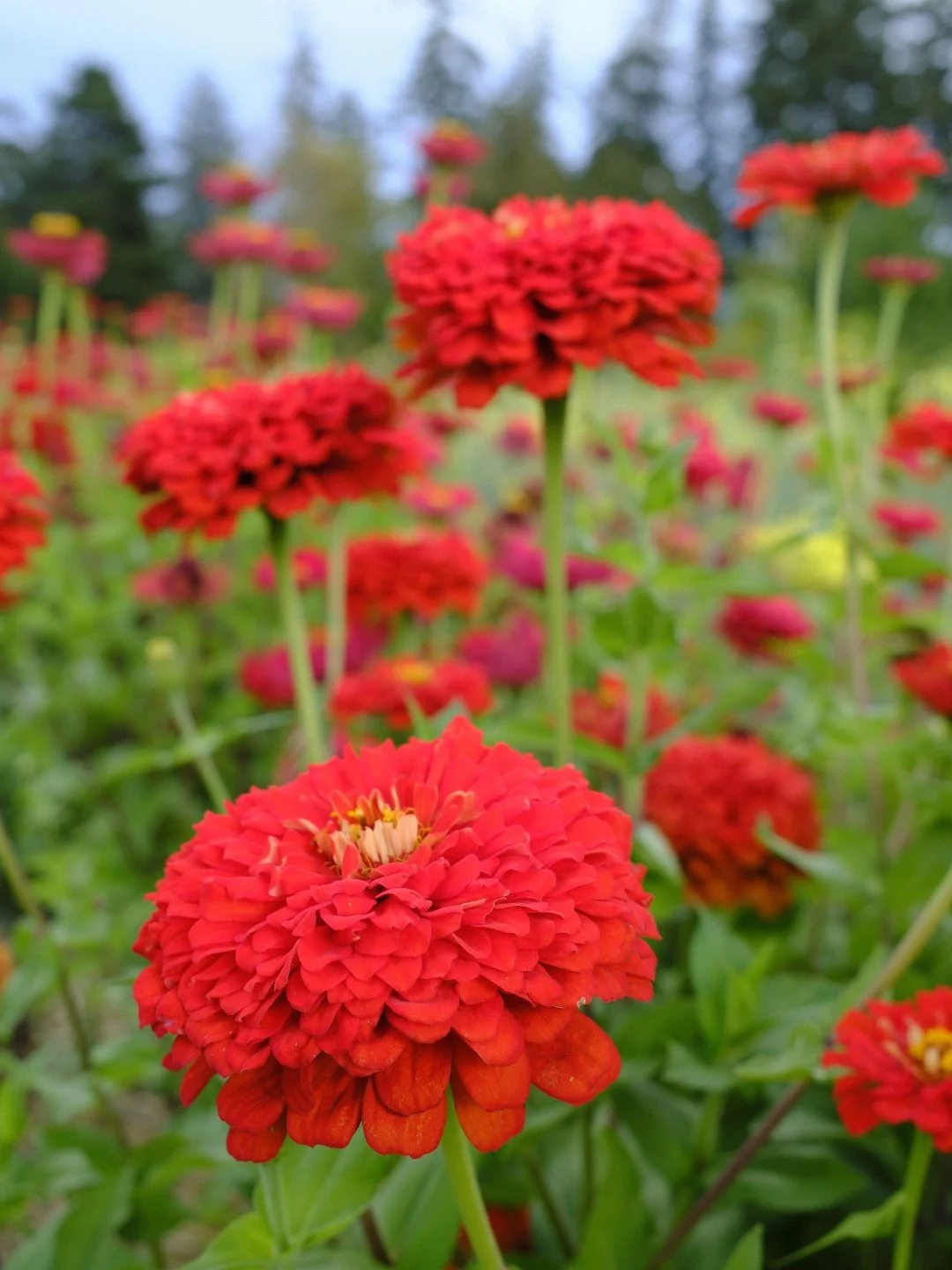
Centro’s group of Latino elders “Edad de Oro” deadheading zinnias during one of their weekly farm visits.
Here's the part I still can't quite believe. We built a fundraising strategy around Metro's Large Scale Community Visions grant, and in early July it looked like we were going to lose out. We'd been invited to apply, but Metro's staff scores projects against a strict rubric. Next to dam removals and greenway expansions, a scrappy little farm-and-youth program just didn't pencil out. We were told, kindly, not to get our hopes up.
So we asked you for help, and you came in force. Saturday crew alumni who aged out years ago wrote to their councilors. So did parents who'd picked up produce at the Mercado during hard months. Afterward, councilor after councilor told us that they had read your emails.
The sheer volume and heart of their testimony made the councilors look past the rubric and ask a deeper question: what does this land actually mean to the people in this community?
On July 14th, Metro Council went beyond its own staff recommendation and put $3 million toward buying this land.. That was the largest award of the whole funding cycle.
I want to thank those councilors directly. It is not easy to set aside a process, in a public forum no less, because your constituents asked you to look again. They listened and ultimately voted to support the project. That's how this is supposed to work, but it doesn't happen often enough. If you have a minute, a quick note of thanks to your Metro councilor would mean more than you'd think.
To everyone who wrote: keep writing. Write to Metro, to Hillsboro City Council, to the school board, to whoever holds the pen on the things you care about. This summer proved those letters get read.
Where this is headed
Here's the plain version. The land is being purchased in partnership with the City of Hillsboro and Centro Cultural, with the Serruriers' discount, Metro's award, and a contribution from the City all going toward the purchase price. When the purchase closes, these 24 acres will become public land held by the City of Hillsboro for the community. Working Theory Farm will keep farming and stewarding the heart of it, so the fields, the youth crews, and the Mercado all stay.
Even with Metro’s award, the Serruriers’ discount, and the City’s contribution, there is still a roughly $3 million gap to close the purchase. We’re working through appraisals, agreements, and a good deal of patient back-and-forth between partners. It's the unglamorous part, and it's moving. We'll be back in your inbox asking for help before too long, and when we are, I have a pretty good idea what you'll do.
Years ago, I planted a patch of epazote here, hoping a few local chefs would want it. It had caught my eye in a seed catalog, and I figured I'd take a risk. It's a scraggly, pungent herb from Mexico and Central America. It smells a bit like turpentine and a bit like mint, and it's what abuelitas put in the black beans. Turns out the demand isn't high in the Italian fine dining scene, so eventually I let it go.
This spring, our elders and the families who come to the Free Food Mercado asked us to bring it back. It isn't more expensive than other things we grow, but you just can't find it locally. For a lot of our neighbors, it smells like a home that's very far away. So we're growing it again, for no better reason than that it matters to the people who asked.
That's the whole farm in a nutshell, really. Plant breeders have a word, landrace, for a crop that isn't one tidy catalog variety. A landrace has been shaped over generations by a particular place and the particular people who kept saving its seed. It changes a little from village to village and garden to garden, but you'd always recognize it. Camas on this valley floor was one, tended by Kalapuya fire for thousands of years. This project opens the possibility of bringing camas back to this land as part of our oak savanna restoration.
I've come to think of Working Theory Farm as a landrace of people.
The Serruriers, our elder visitors, the families at the Mercado, a few hundred letter-writers, and my own kids running between the beds have all been selecting for something without quite naming it.
For now, I just wanted you to have the whole story, land and people together, and to say thank you. Truly.
With gratitude and dirt under my nails,
Justin
Founder and Board Chair, Working Theory Farm
P.S. If you're one of the people who wrote a letter this summer, thank you, and know that it mattered. If you meant to and didn't get around to it, don't worry. You'll get another chance soon.